Where the wild things are
Donna McKinnon - 8 October 2026
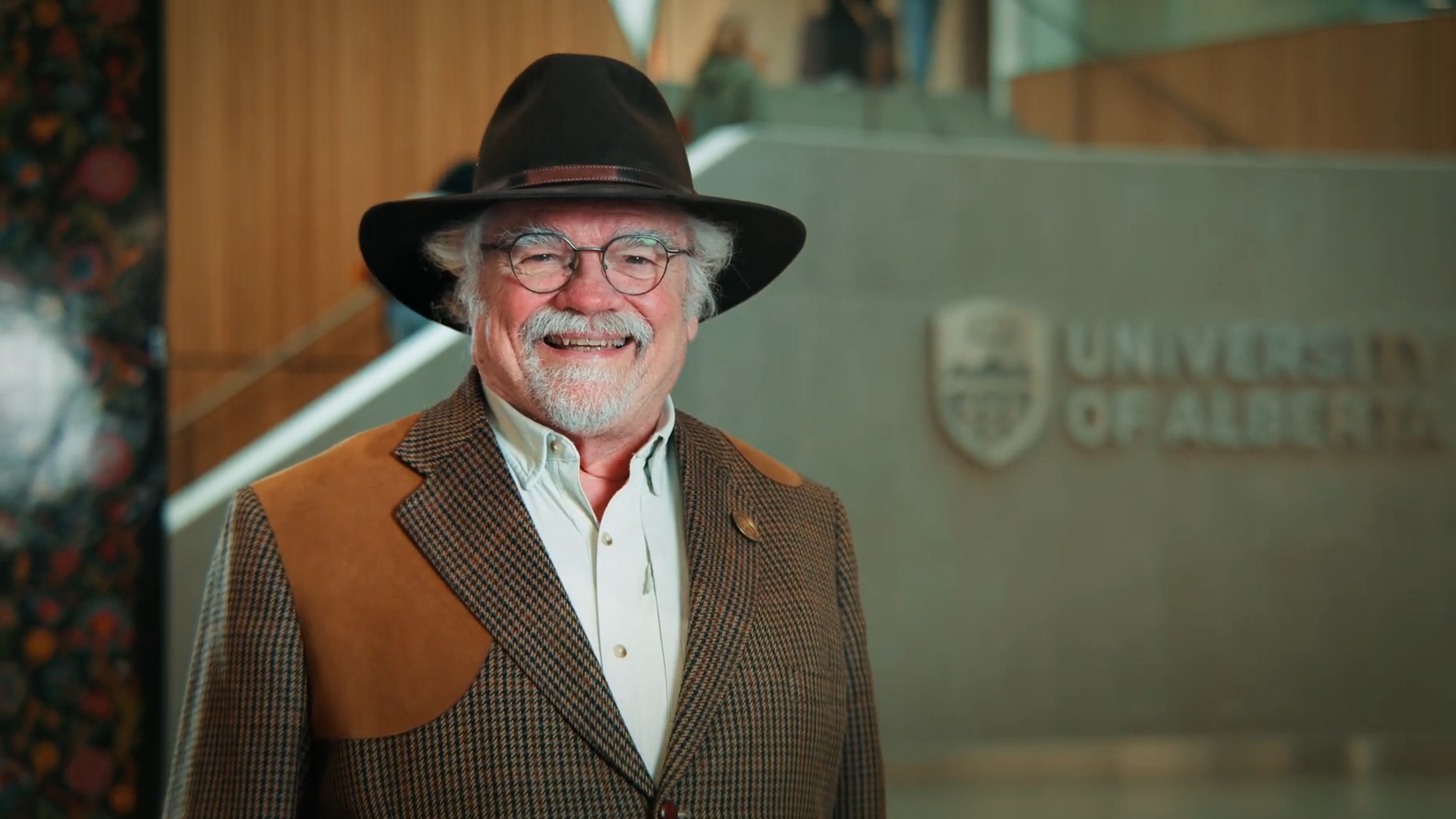
Dr. Mark Boyce, Professor of Biological Sciences in the Faculty of Science
Deep in northwestern Alberta, a presentation to a classroom of school children in High Level by one of Dr. Mark Boyce's graduate students led to an unexpected breakthrough. Excited by the wolverine research they had just heard, the children brought the stories home to their parents — turning early community ambivalence into genuine engagement.
Soon after, Elders from the Dene Tha' First Nation invited Boyce and his student to a fly-in retreat at Bistcho Lake. “It was to go fishing for a couple of days and meet with the Elders,” Boyce explains, noting that the meeting was also an opportunity to discuss how their project could align with local priorities and weave traditional knowledge into wildlife research. It marked a turning point in his relationship with Indigenous communities. The Dene Tha' offered to financially support student research while the local children actively participated in field preparation by helping to build traps.
For Boyce, that experience captured a fundamental truth he has championed throughout his 50-year career: effective wildlife science must be grounded in community connection. It is this philosophy — combining rigorous quantitative science with deep-rooted collaboration — that has made Boyce one of the world’s most influential ecologists, earning him the 2026 University Cup, the institution’s highest honour.
The ACA Endowed Chair in Fisheries and Wildlife, Boyce’s pioneering quantitative models have transformed population management across the globe. Yet his legacy extends far beyond metrics, encompassing decades of championing Indigenous co-management, pioneering grassland conservation and carbon sequestration, and equipping generations of young scientists for environmental stewardship.
That lifelong devotion to ecology traces back to his childhood on a farm in northern Iowa, where he spent every spare moment hunting and fishing. When he discovered that his love for wildlife could become a career, his future was set. “I learned this could be a profession, and from that point on, I put my blinders on and I still haven’t changed my mind about it,” he muses. “It couldn’t have turned out better.”
After receiving his PhD from Yale University, he had several academic roles in the United States before joining the University of Alberta in 1999 along with his wife, Dr. Evelyn Merrill, professor emerita in the Department of Biological Sciences.
Policy impact
Beyond community-led conservation, Boyce’s research has repeatedly shaped national environmental policy. In 2007, his team published groundbreaking habitat modeling work in Ecological Applications, a top tier ecological journal, that mapped critical habitat for endangered sage grouse in southeastern Alberta. When the federal government’s 2008 recovery plan omitted critical habitat identification — violating the Species at Risk Act — the environmental law organization Ecojustice invited Boyce to join a lawsuit against the government.
Hesitant about potential institutional fallout from suing a major university funder, Boyce sought advice from his department chair, the late Dr. Laura Frost.
“I went to see Laura, and she said, ‘That's why we hired you. Get after it’”, he recalls. “We sued the federal government, and we won.” The government then hired 75 people to conduct this crucial habitat modeling work, fundamentally changing the process nationwide. “It was rewarding to see that our research transformed wildlife management practices.”
That policy-defining work laid the groundwork for his ongoing research into the predator-prey dynamics of large carnivores — cougars, elk, bears and wolves — and human-wildlife coexistence across Alberta.
“I think we do a much better job of working with large carnivores than we did 30 years ago,” says Boyce, pointing to effective programs like BearSmart that help educate landowners and tourists about bear interaction safety. “We've even got bears, or at least, a bear, in the city of Edmonton,” he laughs, referring to several recent sightings in the river valley.
Boyce says these types of sightings reflect a broader shift from lethal control toward data-informed cohabitation.
"I work on the premise that humans can coexist with wildlife, and this enriches our lives," he says. "There is a substantial role for science in this, using research to find management practices that allow industrial development and wildlife populations to occur on the same landscape. Habitat loss remains a serious concern, but I'm optimistic that we're learning to manage it far more effectively.”
Math, models and mentorship
Teaching students how to generate that rigorous data remains one of Boyce's proudest contributions. He emphasizes that modern conservation relies as much on high-level quantitative calculations as it does on field skills.
"A lot of people go into wildlife ecology because they don't want to do the hard math, but it's essential,” he says. “Calculus, statistics, probability theory, GIS, computer science, AI — it’s all important, and that's where the jobs are." Developing these core competencies gives young scientists a distinct advantage in an industry that demands data-driven solutions. The majority of his students have gone on to careers in academia, government or environmental consulting.
For Boyce, seeing his former students apply these tools to solve real-world ecological challenges represents the ultimate fulfillment of a 50-year career — one that transformed a childhood love of the outdoors into a global legacy of wildlife stewardship.
I’m having too much fun
In addition to the University Cup, Boyce was previously elected a Fellow of the Royal Society of Canada in 2014. The Royal Society then awarded him the 2016 Miroslaw Romanowski Medal, which recognizes scientific contributions to solving environmental problems and improving ecosystems across land, air and water.
Referring to the University Cup as a career capstone, Boyce quickly clarifies that he has no plans to retire — yet. The line between work and personal life is razor-thin, and hunting, fishing and spending time outdoors are through-lines in both. Alberta’s landscape and its opportunities for unparalleled wildlife encounters, he says, is a constant source of inspiration. Lately, that passion has expanded to include training his Labrador retriever and becoming a self-described ‘crazy bird-watcher’.
“I love working with graduate students,” he says, adding that his endowed chair is designed specifically for this role. “And, I’m just having too much fun.”