Program | Diamond Exploration and Research Training School
Program Aim
To create the next generation of highly qualified, better industry-prepared geoscientists to be diamond and mineral exploration geoscientists through an enhanced industry-based learning experience.
Training Program Outline
DERTS is a graduate student program for both the Master's and Doctoral levels. Students enrolled with DERTS will be trained in the use of the most advanced analytical instrumentation, modelling techniques and interpretation of geophysical data, all of which will be integrated with field-based geological training and education about the unique issues involved with working in Canada's North. The combined diamond, kimberlite and mineral deposit expertise at the University of Alberta (U of A) and University of British Columbia (UBC) covers all areas associated with diamond and mineral exploration and research, facilitating training in all the key aspects associated with exploration. A keen emphasis of the program will be on fieldwork, rock identification and core-logging-skills, which are essential skills sought by industry.
The cornerstones of the training program are:
-
- Annual internships within the diamond mining and exploration industry. Students will spend a minimum cumulative 20% of their active program duration as interns embedded within industry. Additionally, national and regional geological surveys will provide opportunities for internships within the government sector.
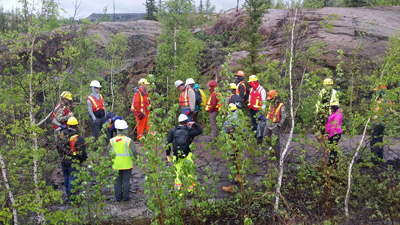
- Student-led introductory field course (alkaline rocks and mantle xenoliths of eastern BC/Alberta/Montana). This aspect of the program engages senior trainees in their 2nd or 3rd years to prepare field guides and deliver outcrop explanations for first-year students with aid from faculty supervision.
- Exploration drill core logging & kimberlite workshop. The course will take advantage of the world- class collections of kimberlite drill core housed at both UBC and U of A to provide intensive instruction and personal mentoring from industry and/or geological survey professionals.
- Specialist theory courses. Industry and government specialists will deliver theory courses on indicator mineral chemistry, exploration geophysics, and use of microdiamonds in grade evaluation.
- Additional technical short courses provided by professional bodies. DERTS trainees will be required to take at least 1 short-course provided by a professional body, such as the Society for Economic Geologists to fulfill their professional development training.
Research Areas and Objectives
DERTS research will focus on innovative research to better understand diamonds, their mantle substrates, and their host kimberlite magmas, that will impact diamond exploration and deposit evaluation.
The key research areas DERTS is focused on include:
- The theoretical and experimental understanding of diamond.
- Micro-macro diamond relations, geochemical testing for genetic relationships, to establish the method on a firmer basis, or to understand more completely its limitations.
- Indicator mineral discrimination of diamond based on new statistical and analytical techniques.
- Mapping the lithospheric mantle with xenoliths using traditional thermobarometry, advanced geotherm modelling and compositional trends in minerals.
- Petrological and geochemical methods to enhance discrimination of magma batches and volcanic facies.
- High precision kimberlite geochronology.
- Geophysical methods for diamond exploration and kimberlite delineation.
- Hyper spectral mapping of kimberlite ore-bodies.
Program Support
DERTS is an industrial stream Collaborative Research and Training Experience (CREATE) program funded by Canada's Natural Sciences and Engineering Research Council (NSERC). DERTS receives significant financial support from the University of Alberta.